
A graduation from Berlin Technical University, followed by experience at BMW and the European Space Agency (ESA)… When Dr. Tarık Öğüt returned to Türkiye in 1990 after a 24-year career, he did not find himself standing behind a university lectern as he had imagined, but rather at the beginning of an entrepreneurial journey.
His original goal had been to become an academic. However, when the political climate of the time and university conditions closed those doors, he founded FİGES in a room of his home in Bursa. The company—whose name stands for Physics, Geometry and Simulation—focused on a technology that Türkiye was largely unfamiliar with at the time: simulation, which allows highly complex systems to be tested in a computer environment.
Having come to the brink of bankruptcy during the 1994 economic crisis, FİGES has since evolved into an engineering company performing some of the most critical calculations for organizations such as ASELSAN and ROKETSAN. Today, part of this technical capability is being directed toward a strategic project aimed at transforming Türkiye’s rich thorium reserves into domestic nuclear energy.
In the 2010s, Dr. Tarık Öğüt crossed paths with Dr. Reşat Uzmen, one of the most prominent figures in Türkiye’s nuclear energy history, opening a new chapter in the story: “Let’s do something that has never been done in Türkiye.” Öğüt describes this collaboration as follows:
“At FİGES we had everything except nuclear expertise. Reşat Bey, on the other hand, possessed a treasure trove of nuclear knowledge and experience accumulated over 40 years. When these two pieces came together, we gained the capability to design the heart of a reactor.”
When this strategic partnership was formed, the two realized that the global race for Molten Salt Reactors (MSR) had already begun. In 2000, the Oak Ridge National Laboratory in the United States released thousands of pages of documents related to its experiments from the 1960s. Seeing that countries from China to France had already begun acting on this data, the team chose not to replicate the past but instead adopted the vision of joining this global race as an ambitious contender.
Unlike conventional nuclear power plants such as Akkuyu, MSRs are considered fourth-generation systems that use fuel in liquid form within molten salt at high temperatures instead of solid fuel rods. This design eliminates the need for the reactor to operate under high pressure and allows the fuel to automatically solidify safely in the event of overheating.
Although the initiative, named ThorAtom, references Türkiye’s rich thorium reserves, the engineering roadmap behind the project is far more pragmatic and strategic. The reactor’s multi-fuel structure allows it to initially use uranium and plutonium—the latter often treated as waste by existing nuclear power plants—as fuel, rather than thorium, whose industrial supply chain has not yet been established. The ultimate goal, however, is to bring thorium, often described as a “nuclear treasure,” into the system.
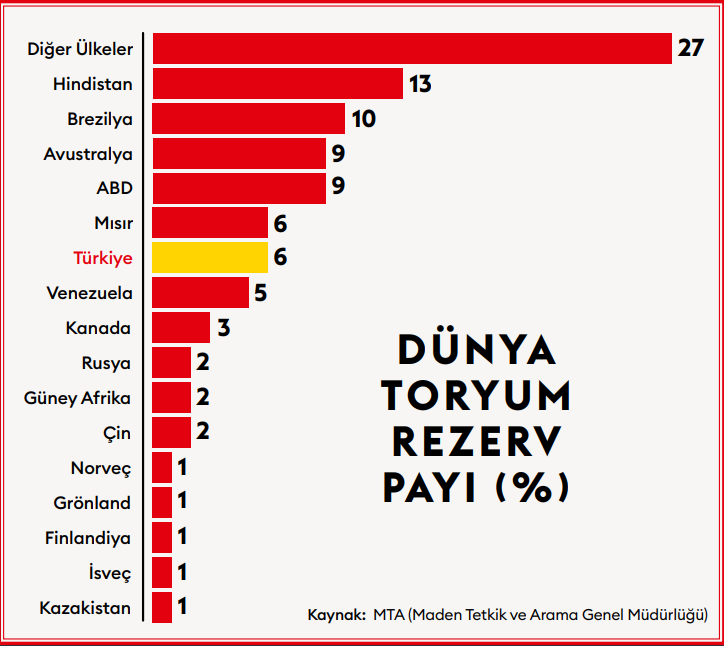
Türkiye possesses one of the world’s notable thorium potentials, particularly in strategic deposits located in Eskişehir-Sivrihisar and Isparta. Although this technology is widely considered revolutionary in the energy world due to its safety and potential cost advantages, it has not yet reached full commercialization in the global nuclear energy market.
In 2014, the European Union launched a project with an approximately €80 million budget to simulate accident scenarios and safety aspects of molten salt reactors under the Horizon 2020 framework. In 2019, FİGES managed to join this initiative—known as the SAMOSAFER project—by proposing a strategic collaboration in exchange for knowledge rather than financial support. Within the project, the company designed the critical heat exchanger systems of the reactor and received approval from European partners.
ThorAtom’s reactor design combines Small Modular Reactor (SMR) architecture with Molten Salt Reactor (MSR) technology. Industry projections suggest that modularity is becoming an economic necessity. According to energy economists, massive projects like the Akkuyu Nuclear Power Plant, which require investments of tens of billions of dollars, create a heavy financing burden in markets such as Türkiye where interest rates are relatively high.
For example, in a $20 billion nuclear project with a 15-year repayment period, interest payments can amount to three to four times the principal. SMRs, by contrast, are often compared to a 1+1 apartment investment—more accessible, scalable, and easier to finance—while large plants like Akkuyu resemble luxury villas.
Recent industry analyses based on data from the OECD Nuclear Energy Agency and the International Energy Agency (IEA) examine expected cost levels in nuclear energy. According to these analyses, the investment cost of large Generation III reactors stands at approximately $6,500 per kWe, while initial installation costs for SMR projects average around $5,500 per kWe. Evaluations referencing IEA’s 2025 projections suggest that, with the introduction of serial production and learning-curve effects, SMR costs could fall to around $3,500 per kWe by 2040, potentially offering up to a 50% capital cost advantage per megawatt.
One of the most important characteristics of the reactors being developed is safety. The system eliminates the high-pressure risk that caused disasters such as Chernobyl and Fukushima. As Reşat Uzmen describes it, the reactor operates at “tap-water pressure,” meaning atmospheric pressure. Thanks to this level of safety, the reactors are envisioned to be installed safely in city centers, university campuses, and organized industrial zones (OIZs).
However, this environmentally friendly solution faces a significant commercial challenge: prototype development and certification costs. The regulatory approvals and lengthy testing processes required for SMRs to be installed in industrial zones place heavy pressure on the project’s financial structure.
The financing of the ThorAtom project reflects a strong entrepreneurial commitment. For FİGES—whose annual revenue is around $15 million—Dr. Öğüt explains that the company has pursued its projects without accumulating funds in the bank, reinvesting every earned dollar into new initiatives. ThorAtom is one of them. Since 2014, the company has invested approximately $2 million of its own resources into this vision.
Now, with support from the Ministry of Industry and Technology, the project is preparing to enter a $100 million R&D phase and a $400 million prototype development stage. In total, the project requires approximately $500 million in capital—clearly a burden too large for FİGES to carry alone in terms of revenue-to-capital ratio. The Ministry has pledged 50% support and regulatory facilitation, and Öğüt states that discussions are ongoing with multiple companies to establish a consortium. Due to signed confidentiality agreements, the names of potential partners cannot yet be disclosed.
The scale of financial commitments from the future consortium and the willingness of the private sector to invest in what is still considered a high-risk R&D project remain critical questions for the project’s future.
Through a technical collaboration with the French nuclear company NAAREA, the planned four-year R&D process is expected to be shortened to two and a half years, accelerating the race against time.
ThorAtom aims to operate its first prototype in the 2030s at a facility planned within the TÜBİTAK Gebze campus, followed by serial production in subsequent years. Once serial production begins, a new market could emerge in which energy investors—similar to those investing in wind (RES), hydro (HES), or solar (GES) projects—purchase reactors and generate electricity commercially.
The system’s commercial potential is not limited to grid electricity. The reactor can also provide a critical energy source for producing green hydrogen and ammonia, fuels widely considered essential for the future. Öğüt and Uzmen also note that the global race—led by countries such as the United Kingdom and China—to integrate fourth-generation reactors into maritime vessels could position ThorAtom not merely as a power plant developer but as a strategic supplier to the global maritime industry, replacing low-quality fuels used in shipping with clean energy solutions.
The excitement surrounding ThorAtom is, in fact, part of a much larger global technology marathon that began years ago and attracts multi-billion-dollar investments. In this new “Atomic Age,” the competitors are not traditional energy giants but unicorn candidates backed by Silicon Valley capital.
One of the most prominent players is TerraPower, founded by Bill Gates, which has begun construction of its reactor in Wyoming with $2 billion in funding from the U.S. Department of Energy. Meanwhile, Google, aiming to meet the enormous energy demands of artificial intelligence data centers, has partnered with Kairos Power and already secured a historic power purchase agreement for reactors to be built in Tennessee.
Other emerging players include ThorCon, which plans to manufacture reactors in shipyards like ship blocks with a $1.2 billion budget for the Indonesian market, and Seaborg Technologies, a Danish company developing floating nuclear power plants in partnership with Samsung.
In this league of giants—where competitors have access to billions of dollars in R&D funding and public support—the call by Turkish engineers for $400–500 million in financing and consortium partnerships is not merely a strategic choice, but a necessary maneuver for survival in the global competition.
Click to view the news.
